Fall Agile Site Visit · Project 12
Site visit evidence
Modernization of the Collision Avoidance Detection System, with the Canadian Space Agency. One section for each rubric criterion: what the Excellent level asks for, the evidence we have, and what is still open.
Snapshot: Nov 13, 2026Live app ↗Repository ↗Project board ↗
- 29
- Evidence ready
- 6
- Partly evidenced
- 0
- Open gap
- 100
- total rubric weight
- Criterion 1Weight 10Project objectives, needs and problem statement1 open item
- Criterion 2Weight 10Stakeholders and market / solution justificationEvidence ready
- Criterion 3Weight 15User stories, non-functional requirements and acceptance criteria2 open items
- Criterion 4Weight 20Architecture, as-built design and technical progressEvidence ready
- Criterion 5Weight 10Roadmap, release planning and backlog managementEvidence ready
- Criterion 6Weight 15Testing, configuration management and quality evidence3 open items
- Criterion 7Weight 15Agile sprint execution and team ownership2 open items
- Criterion 8Weight 5UDL, sustainability, safety and consequences2 open items
Criterion 1
Project objectives, needs and problem statement
Clear objectives, well-defined problem and measurable intended outcomes tied to user needs.
Still open
- Get CSA to confirm the 5-minute and 10-second targets and the Pc tolerance (open decisions 3 and 5).
- Clear objectivesEight objectives, O1 to O8, each with the evidence that will show it is met.Evidence ready
- Well-defined problemOne problem statement, backed by the six sample CDMs that look like one event but are two passes 90 minutes apart.Evidence ready
- Measurable intended outcomesThree key performance parameters with numbers (5 minutes, 10 seconds, agreed Pc tolerance). The targets are ours and still need CSA approval.Partly evidenced
- Tied to user needsFive needs, P1 to P5, taken from CSA's stakeholder scenarios. Each objective names the needs it serves.Evidence ready
Problem statement
How can we help satellite operators and flight dynamics analysts spot the close passes that matter, understand how the risk changes, and compare ways to avoid a collision accurately and efficiently, while keeping the data intact and secure, and leaving every decision to a person?
- Telling passes apart
- Several messages can describe one pass, and the same two objects can have separate passes.
- Risk that keeps changing
- Pc, uncertainties and covariances change with every message, so trend history matters.
- Limited time
- The closer the pass, the faster it has to be reviewed.
- Understanding the numbers
- A risk value only makes sense next to its uncertainty, radial separation and observation age.
- Safe and traceable data
- Mission data can be restricted, and every decision must trace back to its source.
Evidence from CSA's sample data: six warnings about SCISAT 1 and one Fengyun-1C debris object looked like one event but were two close passes about 90 minutes apart.
Objectives, the evidence for each, and where it stands
| ID | Objective | Intended evidence | Needs | Now | Note |
|---|---|---|---|---|---|
| O1 | Preserve the integrity of incoming conjunction data. | Tests comparing imported values with the six source CDMs. | P1, P2 | Verified | Pc text is kept exactly; zero stays distinct (AC02 test). |
| O2 | Distinguish separate encounters from successive updates to the same encounter. | The six samples split into two encounters, with history kept. | P1 | Verified | Passes in all 720 file orders (AC01 test). |
| O3 | Make changes in encounter conditions understandable. | Demo of encounter details, time to TCA, miss distance, Pc and data quality. | P1, P2 | Built | Operator and specialist views, CDM history, trend charts, near-miss player. |
| O4 | Support configurable monitoring and notifications. | Acceptance tests for filters, alerts, notifications and failures. | P5 | Built | Rule editor, outbox, mute and snooze. Delivery is a local simulation. |
| O5 | Establish confidence in scientific risk calculations. | Match with CSA-approved reference cases within an agreed tolerance. | P2 | Prototype | Our 2D Pc matches the source Pc within 1% on three synthetic CDMs. Not validated against CARA. |
| O6 | Support evaluation of potential maneuver alternatives. | Reviewed scenario demo with stated assumptions and criteria. | P2 | Prototype | Impulsive trade study exists in code with assumptions and limits. Not on screen yet. |
| O7 | Support controlled information exchange. | Interface documentation and access-control tests. | P3, P4 | Planned | The Python REST API exists without authentication. Access control is R2. |
| O8 | Deliver a maintainable capstone product. | Source code, repeatable tests, documentation, open-source licence. | All | In progress | Repository, README and tests exist. Licence is an open decision for CSA. |
User needs
- P1
As an on-call operator, I want to identify serious conjunction warnings and see how their risk has changed over time so that I can prioritize events for review.
- P2
As a flight dynamics analyst, I want to evaluate maneuver alternatives against a collision-probability threshold so that I can compare potential mitigation options.
- P3
As a ground-system developer, I want to exchange conjunction and proposed maneuver-plan information through an API so that systems can interoperate.
- P4
As an organization administrator, I want satellite information restricted to authorized users so that other organizations cannot access it.
- P5
As an operator, I want to configure retrieval filters and alert conditions so that warnings reflect the monitoring criteria relevant to my responsibilities.
Measurable outcomes
Ingestion-to-display latency NFR02
Time from CDM retrieval to dashboard display or alert queueing.
< 5 min
Operator comprehension speed NFR06
Time for an operator to find the critical values in a supervised usability check.
< 10 s
Scientific calculation accuracy NFR03
Calculated Pc against CSA-approved reference benchmarks.
Agreed tolerance
Criterion 2
Stakeholders and market / solution justification
Stakeholder interests and participation are understood; alternatives and project value are evidenced.
Still open
- The power-interest ranking is our first estimate. Confirm it with CSA and the supervisor.
- Stakeholder interests understoodNine stakeholders with their interests and needs, ranked on a power-interest grid.Evidence ready
- Stakeholder participationDated meetings with the supervisor and CSA. Each one changed the backlog: see the participation log.Evidence ready
- Alternatives evidencedEight existing products and services compared, plus five design trade-offs with the option we rejected.Evidence ready
- Project value evidencedCSA receives each event as an Excel file by email, one tab per CDM. No reviewed service gives one web view of an event's history with access control.Evidence ready
Stakeholders, interests and needs
| Rank | Stakeholder | Interests and needs | Engagement |
|---|---|---|---|
| 1 | CSA project sponsor and technical contact | Sets scope, expectations, acceptance criteria and handover requirements. | Manage closely |
| 2 | Faculty supervisor and ENG 4000 course staff | Assess technical quality, progress and deliverables. | Manage closely |
| 3 | On-call operator (John) | Spot urgent encounters, follow changes, and know what needs investigation. | Keep informed |
| 4 | Flight dynamics analyst (Sally) | Detailed data, trustworthy risk numbers and maneuver comparison. | Keep informed |
| 5 | Ground-system developer (Casey) | Documented interfaces for event and maneuver-plan data. | Keep informed |
| 6 | Organization administrator | Access permissions and protection of its own satellite data. | Keep informed |
| 7 | CSA management and operational reviewers | Traceable decisions and clear authority over maneuvers. | Keep satisfied |
| 8 | Space-Track, TraCSS and other data providers | Set data formats, access conditions and redistribution rules. | Keep satisfied |
| 9 | Wider space community and public | Responsible space operations and less orbital debris. | Monitor |
Power-interest grid
| Lower interest | Medium interest | Higher interest | |
|---|---|---|---|
| Higher power | Keep satisfied
| Keep satisfied
| Manage closely
|
| Medium power | No stakeholders | No stakeholders | Keep informed
|
| Lower power | No stakeholders | Monitor and consider
| No stakeholders |
Participation log
| Date | Who | What happened | What it changed |
|---|---|---|---|
| Oct 5, 2026 | Prof. Regina Lee (supervisor) | Kick-off. Agile chosen as the method. | Research the domain first, then bring CSA proposed options, not open questions. |
| Oct 22, 2026 | CSA (email) | Four stakeholder scenarios and planning context. | Became needs P1 to P5 and the 14 user stories. |
| Oct 23, 2026 | Prof. Regina Lee | Reviewed research and the questions for CSA. | Questions narrowed to users, workflow, filters, alerts, maneuver analysis and minimum scope. |
| Nov 6, 2026 | Patrick (CSA), Prof. Regina Lee | MVP demonstration and sprint review. | Eight pieces of feedback, turned into an 18-item checklist. 17 done, 1 partly done by Nov 12. |
| Nov 11, 2026 | Prof. Regina Lee | Demo of v0.2 with operator and specialist views. | Asked for a big-picture view, a visual of a conjunction and a way to browse many events. Delivered as /vision and the v0.3 dashboard. |
Alternatives and why CADS is needed
| Product or service | Relevant capabilities | Relevance to CADS |
|---|---|---|
| CSA CRAMS | Pre-analysis, risk assessment, maneuver evaluation, reporting | Main reference for CSA's workflow |
| Space-Track | Catalog and conjunction data for authorized users | Possible data source; restricted access |
| TraCSS | U.S. civil space-traffic coordination | Possible data source or integration reference |
| SOCRATES Plus | Searchable close-approach predictions | Reference for presenting and searching events |
| Kayhan Space Satcat | Commercial space-traffic management | Comparator for workflows and integration |
| LeoLabs LeoSafe | Commercial monitoring, alerts and analytics | Comparator for alerting and risk display |
| EU SST | Collision-avoidance services for member users | Reference for service delivery |
| NASA CARA tools | Conjunction-assessment guidance and software | Source of methods and test cases |
CSA currently receives each event as an Excel file by email, with one tab per CDM. None of the reviewed services gives CSA a single web view that follows an event's updates over time, explains how far each number can be trusted, and shares data through a documented, access-controlled interface. CADS fills that gap as a maintainable, open-source tool that reuses existing scientific methods. It does not claim better tracking accuracy than commercial providers, and it does not replace all CRAMS functions.
Criterion 3
User stories, non-functional requirements and acceptance criteria
Prioritized, testable user stories and nonfunctional requirements with acceptance criteria and traceable coverage.
Still open
- AC04 (access control) has no test yet because accounts are planned for R2.
- NFR thresholds need CSA sign-off.
- Prioritized user stories14 stories in 8 epics, each with a MoSCoW priority, source and target release.Evidence ready
- TestableSix acceptance criteria written as Given / Then. Three already have an automated test named after the criterion, and two more are covered in part or in full.Evidence ready
- Non-functional requirementsTen NFRs with a verification method and target sprint. Thresholds are initial targets, not yet approved by CSA.Partly evidenced
- Traceable coverage18 functional requirements traced to stories, objectives, method, sprint and evidence. Story status below is linked to tests and releases.Evidence ready
User stories
| ID | Epic | User story | Source | Priority | AC | Release | Now | Evidence |
|---|---|---|---|---|---|---|---|---|
| US01 | E1 | Import valid CDMs and identify invalid input. | CSA | Must | AC02 | R1 | Verified | Parser and invalid-input tests (web and Python) |
| US02 | E1 | Associate successive CDMs with the correct encounter. | CSA | Must | AC01 | R1 | Verified | Six samples form two encounters in every file order |
| US03 | E2 | View and sort encounters by TCA, risk and status. | P1 | Must | AC01 | R1 | Built | Event list with search, filters and sort (v0.2.5, v0.3) |
| US04 | E2 | Review risk and miss-distance trends across revisions. | P1 | Must | AC02 | R1 | Built | CDM history table and trend charts (v0.2) |
| US05 | E3 | Configure retrieval criteria and alert thresholds. | P5 | Must | AC03 | R1 | Built | Rule editor with change history (v0.3) |
| US06 | E3 | Receive notifications and inspect delivery outcomes. | P5 | Must | AC03 | R1 to R3 | Prototype | Outbox with status, retry, mute and snooze. Delivery is simulated locally |
| US07 | E4 | Inspect source data, uncertainty and risk provenance. | P2 | Must | AC02 | R1 | Built | Specialist view, original CDM fields, 'How this was calculated' |
| US08 | E5 | Compare maneuver scenarios using an agreed method. | P2 | Must | AC05 | R2 to R3 | Prototype | Trade-study code and API endpoint; method not agreed with CSA |
| US09 | E4 | Validate calculations against reference cases. | CSA | Must | AC02 | R2 | Planned | CARA review written (docs/cara-review.md); validation not started |
| US10 | E6 | Exchange event and maneuver-plan data through an API. | P3 | Must | AC05 | R2 | Prototype | Python REST API with OpenAPI docs; no authentication yet |
| US11 | E7 | Enforce organization-level and role-based access. | P4 | Must | AC04 | R2 | Planned | Design only |
| US12 | E7 | Close events with a recorded reason. | CSA | Should | None | R2 to R3 | Prototype | Archive and restore in the web app; status endpoint with audit entry in Python |
| US13 | E8 | Access setup, API and schema documentation. | CSA | Must | AC06 | Every release | In progress | README, docs/data-model.md, fixtures PROVENANCE.md |
| US14 | E8 | Inspect retrieval, processing and notification failures. | Course guidelines | Must | AC03 | Every release | Built | Import report with reject reasons; delivery log per outbox entry |
Epics: E1 Data integrity and encounter identification · E2 Operator monitoring · E3 Alerts · E4 Scientific assessment · E5 Maneuver evaluation · E6 Interoperability · E7 Privacy and audit · E8 Quality and handover
Acceptance criteria and the tests that check them
Given the six supplied CDMs in any file order, the system must identify two distinct close approaches and associate the appropriate messages with each encounter.
Checked by
- tests/test_mvp.py: test_ac01_two_encounters_in_every_file_order
- web: lib/cads/cads.test.ts (grouping, one-at-a-time loading)
Criterion 4
Architecture, as-built design and technical progress
Working increment or credible demonstration; current architecture/UML and implementation evidence match the as-built system.
Still open
- The recalculated Pc is not yet validated against NASA CARA reference cases (R2).
- Accounts, organizations and API authentication are not built (R2).
- PostgreSQL is supported by URL in the Python app but not tested. The web app stores data in the browser.
- Working increment or credible demonstrationFour tagged releases since Nov 6. v0.3 beta is live on Vercel and can be demonstrated during the visit.Evidence ready
- Current architecture and UMLAs-built component, class, sequence and state diagrams, drawn from the code on Nov 13. PlantUML sources are in docs/diagrams.Evidence ready
- Match the as-built systemA design-against-built table lists every place where the system differs from the proposed design in Progress Report 1, and why.Evidence ready
- Implementation evidenceEach increment is linked to its Git tag and pull requests. Automated tests cover the domain logic.Evidence ready
System architecture
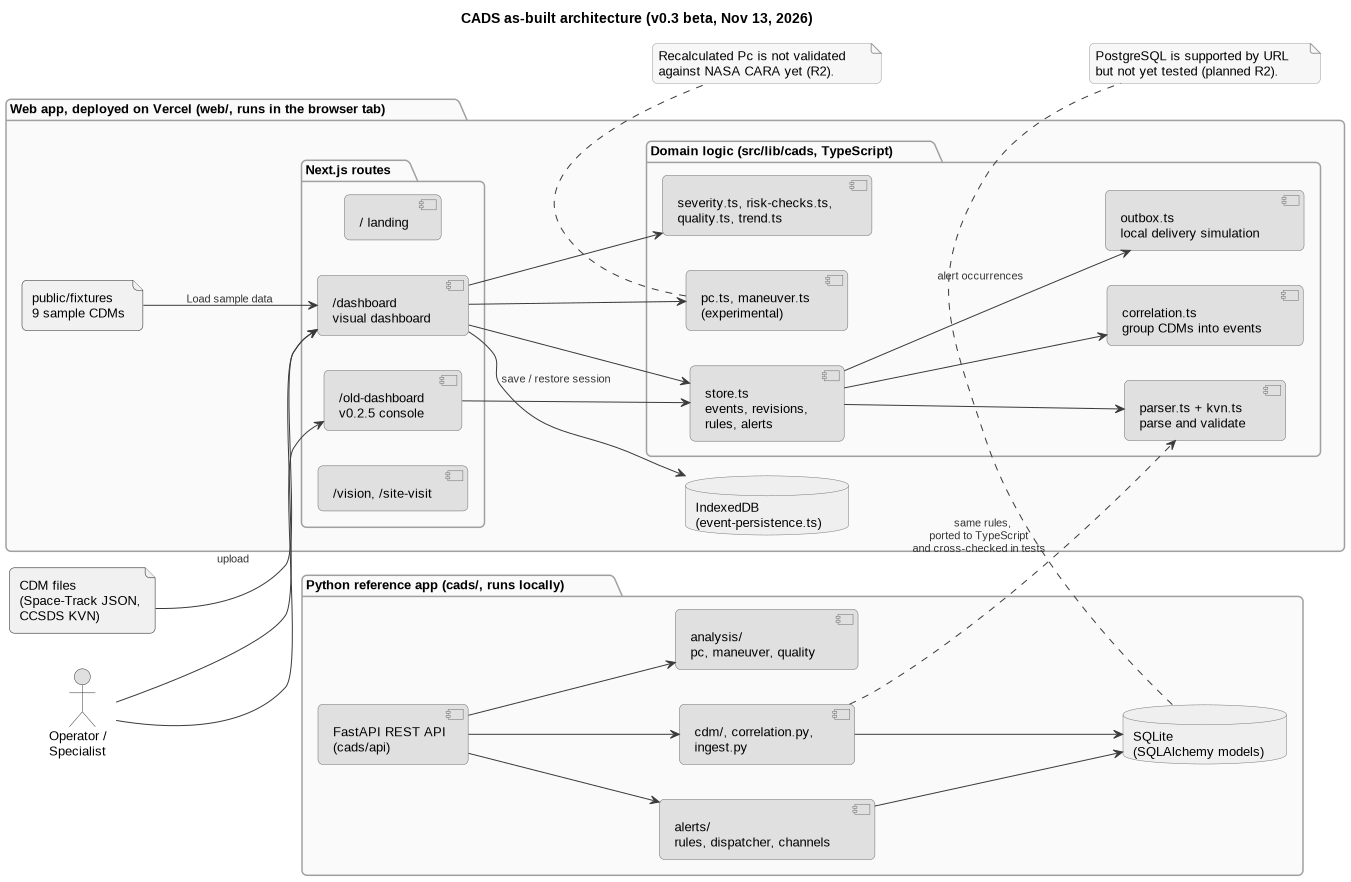
| Area | Proposed | Built today | Why | Match |
|---|---|---|---|---|
| Frontend | React, Next.js, TypeScript, Tailwind CSS | Next.js 16, React 19, TypeScript, Tailwind CSS 4 | As designed. | Matches |
| Ingestion and validation | Python backend service | Python module (cads/cdm) and a TypeScript port (parser.ts, kvn.ts) | The port lets the demo run on Vercel's free tier with no server. Tests check it against the Python results. | Matches |
| Event correlation | Python backend service | Same rule in Python and TypeScript: object pair plus a 60 s TCA window | The 60 s window is our proposal, to confirm with CSA. | Matches |
| Database | PostgreSQL | SQLite in the Python app; IndexedDB in the browser | No hosting cost or credentials during the fall. The storage interface is ready for a PostgreSQL adapter. | Differs for now |
| API | FastAPI REST with access control | FastAPI REST with OpenAPI docs, no authentication | Access control is scheduled for R2. | Differs for now |
| Alerts | Alert processing with email and SMS | Rules, outbox, retry, mute and snooze. Web delivery is simulated; Python has file and webhook channels | A browser-only app cannot send email. CSA has not confirmed the channels. | Differs for now |
| Risk and maneuver analysis | NASA CARA tools | Own 2D Pc and impulsive trade study, labelled experimental | Severity always comes from the source Pc. CARA validation is R2. | Differs for now |
| Users and organizations | User, Organization, Membership | Not built | Scheduled for R2 (US11). | Not built |
| Layer | Technology | Reason |
|---|---|---|
| Frontend | React 19, Next.js 16, TypeScript, Tailwind CSS 4, shadcn and Animate UI components | Browser-based access without installing software |
| Visuals | SVG with GSAP, three.js for the landing page | Near-miss player and trend charts without a chart library |
| Backend | Python 3.10 | Team familiarity and strong scientific libraries |
| API | FastAPI | Lightweight REST API and external integration |
| Storage | SQLite now, PostgreSQL planned; IndexedDB in the browser | Data consistency and structured relationships |
| Tests | Vitest with Testing Library; pytest | Fast unit and click-through tests in both codebases |
| Hosting | Vercel free tier | Zero hosting cost for the fall term |
UML diagrams
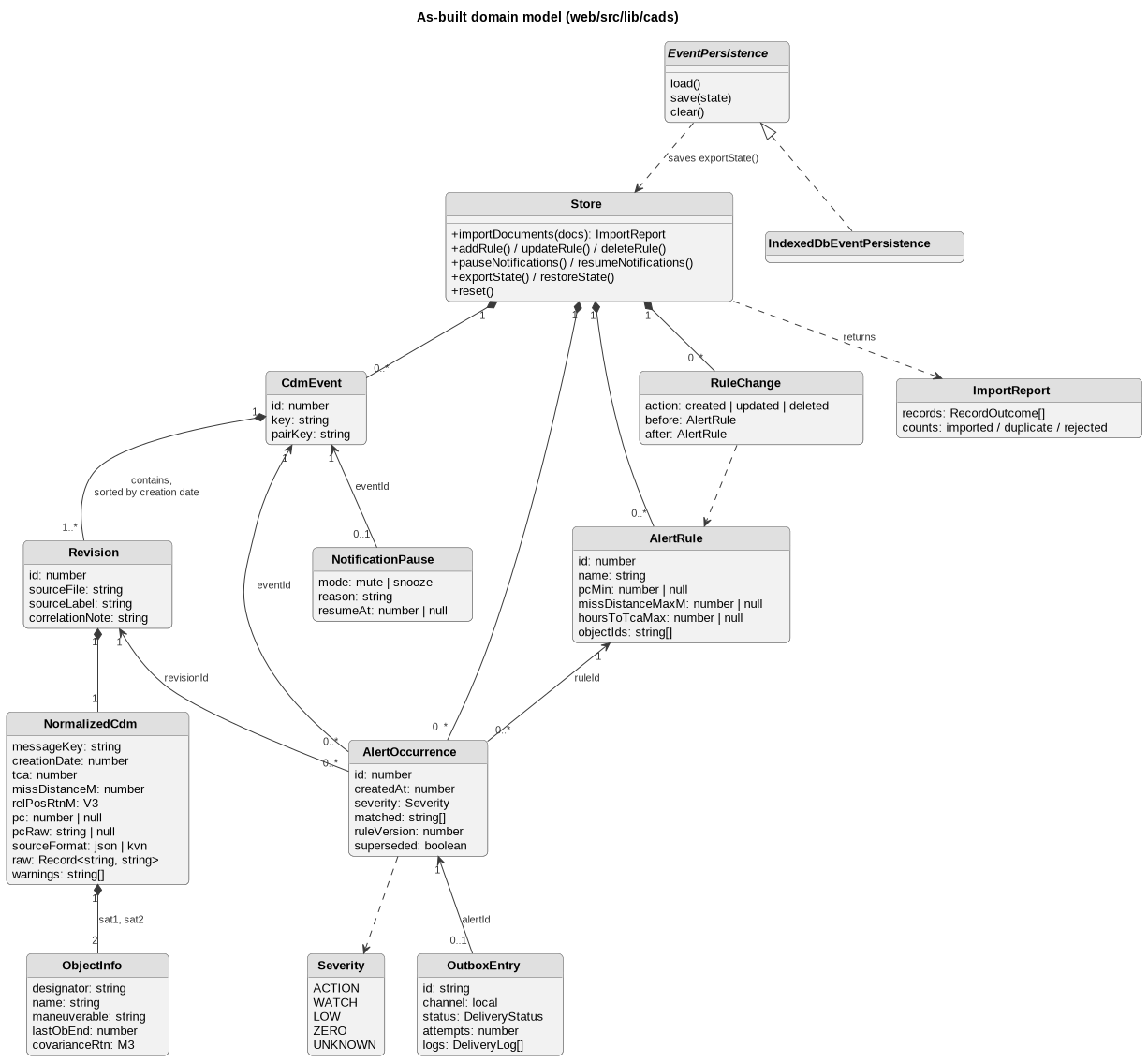
The as-built diagrams are generated from PlantUML sources in docs/diagrams, so they are version-controlled with the code they describe.
Functional increments
- v0.1v0.1-nov6
Nov 6, 2026 · Sprint 3
MVP shown to CSA
- Imports the six sample CDMs and rejects invalid input
- Groups them into two encounters in any file order
- Frontline summary: time to TCA, miss distance, source Pc
- Python app with REST API, alert rules and outbox
Sprint 3 review with Patrick (CSA) and Prof. Lee
- v0.2v0.2-nov11
Nov 11, 2026 · Sprint 4
CSA feedback, first half
- Operator view and specialist view
- Radial, in-track and cross-track miss distance
- CDM history table and Pc / miss-distance trend charts
- CDMs load one at a time, oldest first
Pull request #1; 9 of 18 checklist items
- v0.2.5v0.2.5
Nov 12, 2026 · Sprint 4
Landing page, console and the rest of the checklist
- Miss distance compared with uncertainty, with a confidence level
- 'How this was calculated' panel with the covariance matrices
- Active and archived events; ACTION flag at Pc of 1 in 10,000
- Landing page and the big-picture page at /vision
Pull requests #2 and #3; 17 of 18 checklist items
- v0.3 betav0.3-beta
Nov 13, 2026 · Sprint 4
Visual dashboard
- Near-miss player with a plain-language verdict
- Two sidebars: event list on the left, event details on the right
- Alert rule editor, outbox with delivery status, mute and snooze
- Four risk checks per event; session saved in the browser
Pull requests #11 to #20, one per team member's issue
- Open the live app and go to the dashboard.
- Press Load sample data. Nine CDMs arrive one at a time and form three events: two SCISAT 1 passes and one synthetic high-risk pass.
- Run the risk analysis. Each event gets a severity from its source Pc.
- Choose the ACTION event and play the pass in the near-miss player.
- Switch the right sidebar between the operator and specialist views. Open the original CDM fields.
- Open the alert rules and the outbox. Retry a failed delivery, then mute an event.
- Refresh the page to show the saved session, then press Reset.
Criterion 5
Roadmap, release planning and backlog management
Realistic feature roadmap, release timeline, prioritized backlog and visible progress against planned increments.
Still open
- The Fall MVP demo date (Dec 18) is still to be confirmed.
- The GitHub issues for merged v0.3 work are still open and need closing or re-scoping.
- Realistic feature roadmapEight epics mapped to features, priority and target release.Evidence ready
- Release timelineFive releases, R0 to R4, on a week-by-week Gantt chart ending on Capstone Day, April 29, 2027.Evidence ready
- Prioritized backlog26 backlog items with story links, relative size, target release and current status.Evidence ready
- Visible progress against planned incrementsR0 is complete. 7 of the 8 R1 backlog items are delivered and the last is in progress, five weeks before the planned Fall MVP demo.Evidence ready
Release timeline and progress
- R0Done
Discovery and design
Sep 28 to Oct 25, 2026
Problem definition, requirements, sample-data study, interface decisions, architecture, backlog
Sprints 1 and 2 finished every planned item with no carry-over.
- R1In progress
Fall MVP
Oct 26 to Dec 2026
Import six CDMs, associate revisions, event details and trends, core alert logic and a test notification path
7 of 8 R1 backlog items delivered (B06 to B11, B13). B12 is in progress: delivery is still a local simulation.
- R2Planned
Scientific and integration increment
Jan to Feb 2027
Pc reference validation, initial maneuver-analysis method, API implementation, accounts and organization permissions
Prototypes exist for Pc, maneuver trade and the REST API.
- R3Planned
Integrated beta
Mar to Apr 2027
Scenario analysis, reliability, accessibility, notification handling and documentation
- R4Planned
Final handover candidate
By Apr 29, 2027
Integrated demonstration, repository, installation and API documentation, test evidence, handover material
Capstone Day.
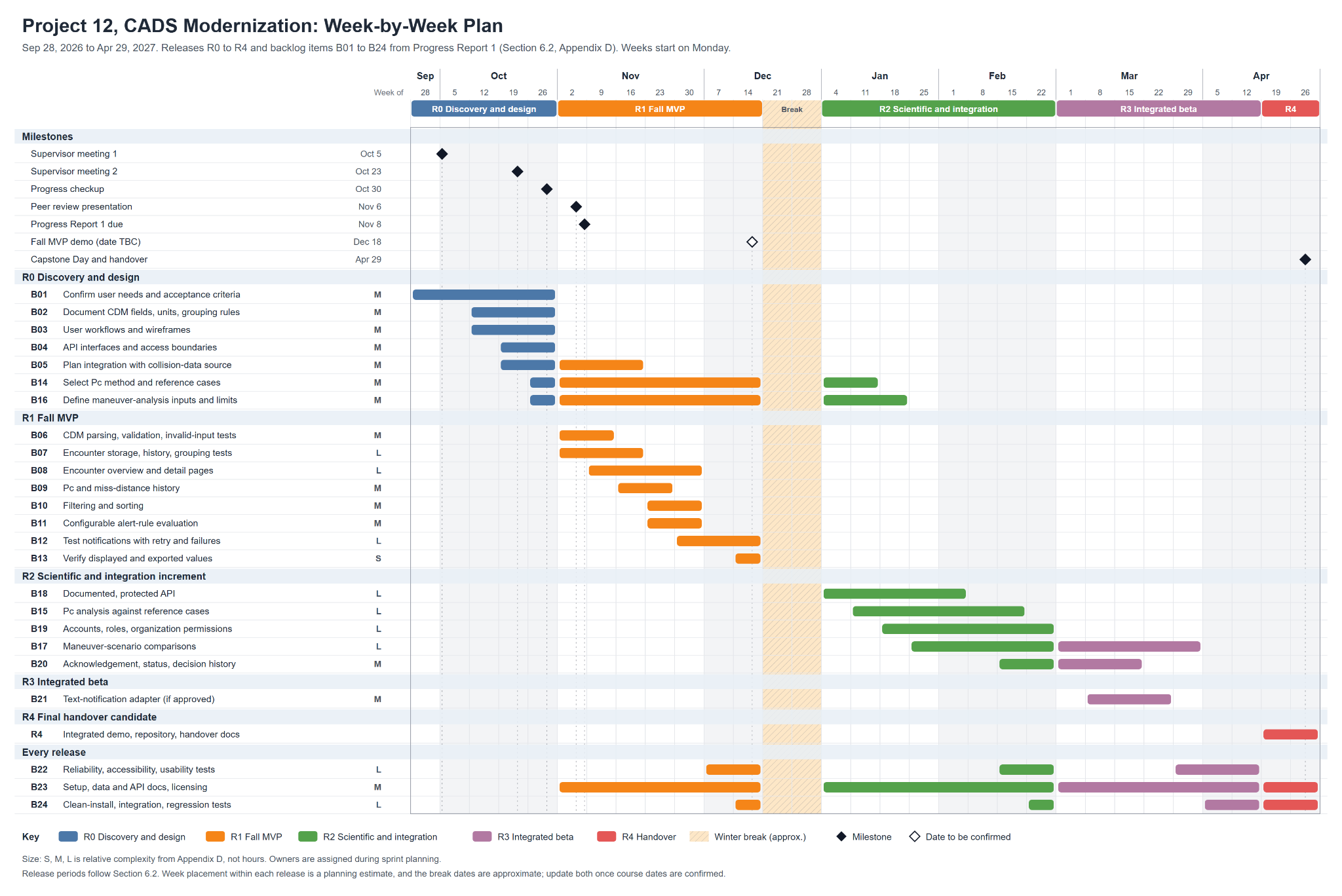
Feature roadmap by epic
| Epic | Main features | Priority | Target release |
|---|---|---|---|
| E1 · Data integrity and encounter identification | CDM import, validation, event correlation, revision history | Must | R0 to R1 |
| E2 · Operator monitoring | Event overview, detailed information, time to TCA, risk trends | Must | R1 |
| E3 · Alerts | Configurable rules, notification status, retries, audit records | Must | R1 to R3 |
| E4 · Scientific assessment | Source-value provenance, quality indicators, Pc reference validation | Must | R0, R2 |
| E5 · Maneuver evaluation | Scenario inputs, comparisons, residual risk, documented assumptions | Must; scope to confirm | R2 to R3 |
| E6 · Interoperability | Authenticated event and maneuver-plan API | Must | R0, R2 |
| E7 · Privacy and audit | User roles, organization isolation, event and configuration history | Must | R0, R2 |
| E8 · Quality and handover | Automated tests, accessibility, documentation, reproducible deployment | Must throughout | Every release |
Product backlog
| ID | Backlog item | Stories | Size | Target | State |
|---|---|---|---|---|---|
| B01 | Confirm user needs and key acceptance criteria with stakeholders. | US01, US03 | M | R0 | Done |
| B02 | Document CDM fields, units and encounter-grouping rules. | US01, US02 | M | R0 | Done |
| B03 | Develop and review user workflows and wireframes. | US03, US07 | M | R0 | Done |
| B04 | Define API interfaces and user access boundaries. | US10, US11 | M | R0 | Done |
| B05 | Plan integration with the real collision-data source. | US01, US05 | M | R0 to R1 | Done |
| B06 | Implement CDM parsing, validation and invalid-input test cases. | US01 | M | R1 | Done |
| B07 | Implement encounter storage, revision history and encounter-grouping tests. | US02 | L | R1 | Done |
| B08 | Develop encounter overview and detail pages. | US03, US07 | L | R1 | Done |
| B09 | Display collision-probability and miss-distance history. | US04 | M | R1 | Done |
| B10 | Add filtering and sorting for encounter data. | US03, US05 | M | R1 | Done |
| B11 | Implement configurable alert-rule evaluation. | US05 | M | R1 | Done |
| B12 | Implement a test notification workflow with retry and failure handling. | US06, US14 | L | R1 | In progress |
| B13 | Verify collision data is displayed and exported accurately. | US01, US07 | S | R1 | Done |
| B14 | Research and select an approved Pc calculation method and reference cases. | US09 | M | R0 to R2 | In progress |
| B15 | Implement and verify Pc analysis against approved reference cases. | US09 | L | R2 | To do |
| B16 | Define the inputs, outputs, assumptions and limits for maneuver analysis. | US08 | M | R0 to R2 | In progress |
| B17 | Implement and validate maneuver-scenario comparisons using the agreed method. | US08 | L | R2 to R3 | To do |
| B18 | Implement documented and protected API interfaces. | US10 | L | R2 | To do |
| B19 | Implement user accounts, roles and organization-level permissions. | US11 | L | R2 | To do |
| B20 | Add event acknowledgement, status updates and decision history. | US12 | M | R2 to R3 | To do |
| B21 | Add a text-notification adapter if approved and feasible. | US06 | M | R3 | To do |
| B22 | Conduct reliability, accessibility and usability tests. | US13, US14 | L | Every release | To do |
| B23 | Prepare setup instructions, data documentation, API documentation and open-source licensing. | US13 | M | R1 to R4 | In progress |
| B24 | Perform clean-install, integration, regression and release testing. | US14 | L | R1 to R4 | In progress |
| B25 | Universal design and accessibility verification: WCAG 2.1 AA keyboard, contrast and ARIA checks. | NFR07 | M | R1 (Sprint 4) | To do |
| B26 | Multi-tenant security audit: automated cross-tenant denial tests and API token scoping. | US11, NFR04 | M | R2 (Sprint 7) | To do |
- The user's needs and intended outcome are clearly understood.
- The acceptance criteria are clear and testable.
- Important dependencies and external interfaces have been identified.
- The required inputs, mock data or test data are available.
- The task is small enough to estimate and complete within a sprint.
- Its acceptance criteria have been met.
- Relevant automated tests have passed.
- Source data and numerical values handled by the feature remain accurate.
- Applicable security, accessibility and error-handling checks have been completed.
- Code changes have been reviewed before being merged.
- Related documentation has been updated when needed.
- Known limitations or unresolved issues have been recorded.
- What format, access method and integration requirements will apply to the CSA-provided synthetic catalog?
- What encounter-grouping rule should be followed when TCA changes?
- Which Pc method and numerical tolerance will CSA accept?
- What level of maneuver-analysis fidelity is expected?
- What notification channels are required for the Fall MVP?
- Does the API support only proposed plans, or must it accommodate a future automation boundary?
- What organization, security, hosting and retention policies apply?
- What are the confirmed course submission and handover dates?
Criterion 6
Testing, configuration management and quality evidence
Version-controlled work, repeatable build, meaningful tests and evidence of requirements coverage and defect tracking.
Still open
- No CI yet: tests run on each developer's machine. GitHub Actions is a Sprint 4 retrospective action.
- The main branch is not protected and no pull request has a recorded GitHub review.
- Defects found by tests are not yet logged as GitHub issues with a bug label.
- Version-controlled workOne Git repository, feature branches, pull requests into main, and a tag for every release.Evidence ready
- Repeatable buildDocumented commands build and test both apps with no credentials. Vercel builds main on every merge.Evidence ready
- Meaningful testsAutomated web tests and Python tests. Tests are named after the acceptance criteria and check the port against the Python results.Evidence ready
- Requirements coverageA coverage table maps each acceptance criterion to the tests that check it.Partly evidenced
- Defect trackingDefects are fixed on fix/ branches through pull requests. Features are tracked as GitHub issues with owners.Partly evidenced
Testing plan
| Test level | What it checks | When | Where it stands | Status |
|---|---|---|---|---|
| Unit | CDM parsing, field validation, alert rules | Every pull request | Automated in both codebases. | In place |
| Integration | Ingestion, grouping, storage and alerts working together | Every pull request | Python API tests and web click-through tests. | In place |
| API and security | Invalid requests, permissions, cross-organization access | Every pull request | Invalid input is tested. Permission tests wait for accounts (R2). | Partly in place |
| Scientific | Pc results against approved reference cases | Each release | Our Pc is checked against the source Pc on synthetic CDMs. No CARA reference cases yet. | Partly in place |
| Usability and accessibility | Keyboard use, labels, supervised review tasks | Each release | Tests query by role and label. No supervised task or WCAG audit yet. | Not started |
| Regression and deployment | Old features still work; clean install from the docs | Each release | The full suite is the regression check. Clean install and both suites repeated for this page. | In place |
Targets
- Over 80% automated coverage on ingestion and processing modules. Coverage is not measured yet.
- 100% coverage of CDM parser edge cases (Sprint 4 item).
- Zero high-severity security issues.
Test evidence
Both suites were run from a fresh install on Nov 13, 2026, on the branch that adds this page (main plus this page). Re-run the commands below to reproduce the numbers.
- Tests
- 126
- Passed
- 126
- Failed
- 0
$ cd web && npm test
- Tests
- 10
- Passed
- 10
- Failed
- 0
$ pip install -r requirements-dev.txt && pytest
| AC | Criterion | Tests | Coverage |
|---|---|---|---|
| AC01 | Encounter identification |
| Covered |
| AC02 | Numerical integrity |
| Covered |
| AC03 | Alert evaluation |
| Covered |
| AC04 | Access control |
| Not covered |
| AC05 | Maneuver analysis |
| Partly covered |
| AC06 | Reproducibility |
| Covered |
Configuration management
| Item | Rule | Evidence | Status |
|---|---|---|---|
| Repository | One shared Git repository for code, fixtures, diagrams and docs. | github.com/eszain/project12_code, 77 commits from 6 members. | Followed |
| Branches | feature/USxx-short-description, fix/issue-description, release/vX.Y. | feature/ and fix/ branches are in use. Some early branches do not follow the pattern. | Partly followed |
| Merge rules | No direct commits to main; one approving review; passing tests; clean secret scan. | 15 pull requests, 13 merged. Reviews are not recorded on GitHub and main is not protected. | Partly followed |
| Versioning | A tag for every release. | v0.1-nov6, v0.2-nov11, v0.2.5, v0.3-beta, with frozen branches for the demo versions. | Followed |
| Secrets | Settings and credentials in environment variables, never in the repository. | .env is git-ignored and .env.example documents the settings. The web app needs no credentials. | Followed |
| Data provenance | Synthetic fixtures are clearly separated from source data. | fixtures/reconstructed and fixtures/synthetic, each described in PROVENANCE.md. | Followed |
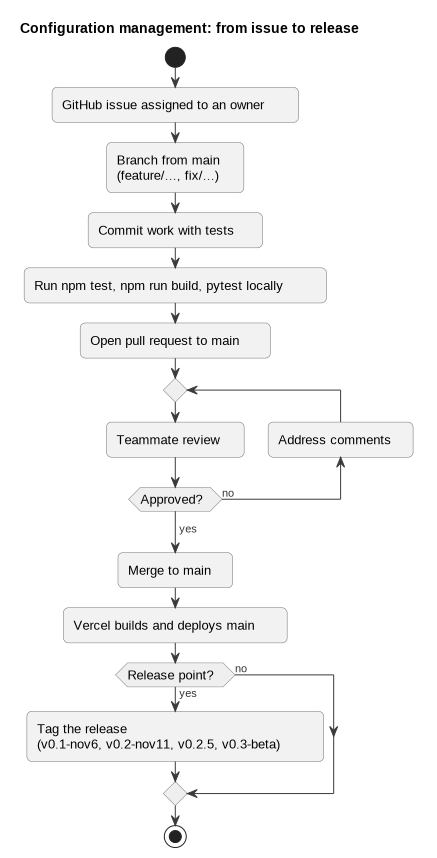
Web app
cd web
npm install
npm test
npm run build
npm run dev   # http://localhost:3000
Python reference app
python -m venv .venv && source .venv/bin/activate
pip install -r requirements-dev.txt
pytest
python -m cads   # http://127.0.0.1:8000, API docs at /docs
Diagrams
cd docs/diagrams
java -jar plantuml.jar -tsvg -o ../../web/public/site-visit *.puml
Defect tracking
| ID | Found | Defect | State | Action |
|---|---|---|---|---|
| D1 | Nov 13, review | A source Pc of exactly 0 was displayed as '0%', which reads as 'no risk'. | Fixed | Branch fix/no-zero-percent, pull request #19, merged Nov 13. Now shown as 'less than 0.0000001%'. |
| D2 | Nov 13, automated test | On the branch of open pull request #21, raw LaTeX text (for example 'frac1') leaks into the 'How this was calculated' panel of the v0.2.5 console. | Open | Caught before merge by components/cads-app.test.tsx. Main is not affected. To be fixed on that branch before it merges. |
| D3 | Nov 11, checklist review | README says nine CDMs become three events while Progress Report 1 says six become two. | Open | Both are true (six CSA samples plus three synthetic). Wording to be aligned in the README. |
Criterion 7
Agile sprint execution and team ownership
Sprint planning, daily coordination, reviews and retrospectives evidenced; team members own work and act on feedback.
Still open
- Two of three Sprint 3 retrospective actions are still open (GitHub Actions, planning poker).
- Keep stand-up notes for Sprint 4 in the repository or the board so they can be shown.
- Sprint planningSprint goals, selected backlog items, capacity and owners for Sprints 1 to 4.Evidence ready
- Daily coordinationStand-ups three times a week on Discord, with logged blockers and how each was resolved.Evidence ready
- ReviewsSprint reviews with CSA and the supervisor on Nov 6 and Nov 11, with the feedback recorded.Evidence ready
- RetrospectivesSprint 3 retrospective with three actions and their current state.Partly evidenced
- Team members own workEvery v0.3 issue has one owner, and all six members have merged pull requests.Evidence ready
- Act on feedbackCSA's Nov 6 feedback became an 18-item checklist: 17 done and 1 partly done within a week.Evidence ready
Sprint boards
A snapshot of each sprint as of Nov 13, 2026. Sprint 4 cards are the GitHub issues and pull requests. The live board is on GitHub: project board ↗
- Sprint goal
- Act on CSA's Nov 6 feedback and complete the operator workflow: two views, trends, covariance in the risk picture, alert rules and delivery logging.
- Dates · release
- Nov 9 to Nov 22, 2026 (in progress) · R1
- Capacity
- About 10 hours per member
To do3
- RETRO-1Retro action
GitHub Actions: run tests on every pull request
Abhishek Lal George
- TESTUS01
Cover 100% of CDM parser edge cases
To be assigned
- B25NFR07
Accessibility verification (WCAG 2.1 AA)
Himanshi Verma
In progress6
- #21Pull request open
Verdict banner redesign for the near-miss player
Mohammed Zain Al Syed
- #9Risk checks merged (#16, #20)
Risk and maneuver data: CARA Pc check and what-if burn study
Sarthak Verma
- #8First part merged (#18)
Alerts: indicators, rule editor, outbox and delivery status
Taehyun Kim
- #7First part merged (#11)
Event data layer: grouping rules, history, active / archived, storage
Manoj Ravichandran
- #6First part merged (#14)
Data loading: import report, validation messages, raw CDM view
Abhishek Lal George
- #5First part merged (#12)
Dashboard sidebars: event rows and operator / specialist details
Himanshi Verma
Done4
- #4Merged (#17)
Near-miss player: 2D playback in the dashboard centre
Mohammed Zain Al Syed
- #1v0.2
Operator and specialist views, CDM history and trends (US03, US04, US07)
Mohammed Zain Al Syed
- #3v0.2.5
Miss distance against uncertainty, calculation panel, archive, ACTION flag
Mohammed Zain Al Syed
- #19Defect D1
Fix: never show a collision chance of 0%
Mohammed Zain Al Syed
- Review
- Demo to Prof. Lee on Nov 11 (v0.2). Sprint review with CSA to follow.
- Unfinished work
- Sprint still running. Issues #5 to #9 stay open until their remaining scope is done or moved.
Cadence and ceremonies
| Ceremony | When | What it produces |
|---|---|---|
| Sprint planning | Every second Monday | Goal, backlog items that pass the Definition of Ready, capacity (about 10 hours per member) and owners. |
| Stand-up | Monday, Wednesday, Friday on Discord | Done, next, blocked. Blockers get an owner. |
| Sprint review | Every two weeks or at a release | Demo to the supervisor and CSA; feedback recorded as backlog items. |
| Retrospective | Every second Monday | Went well, to improve, actions with owners. |
| Who | Done | Next | Blocked by |
|---|---|---|---|
| Abhishek Lal George (backend) | FastAPI CDM file upload endpoint (US01). | Unit tests for invalid payload rejection. | No sample JSON files with 3D covariance matrices. |
| Himanshi Verma (frontend) | React layout for the frontline event cards (US03). | ARIA accessibility tags (B25). | None |
| Taehyun Kim (database) | Schema migrations for ConjunctionEvent and CDMRevision (US02). | Queries for grouping revisions by TCA. | None |
Impediments raised and resolved
- Space-Track access restriction: live catalog data was unavailable. Switched to the ESA synthetic CDM dataset on CSA's advice.
- Covariance data gap: the six sample CDMs lacked rich covariance data. Sarthak Verma built synthetic covariance test fixtures.
Went well
- The MVP demo to CSA.
- Early collaboration between backend parsing and database design.
To improve
- Manual pull-request testing delayed the demo.
- The effort for event correlation was underestimated.
Actions
- Set up GitHub Actions to run tests on every pull request. Abhishek Lal GeorgeOpen
- Split operator and specialist views. Himanshi VermaDone (v0.2)
- Use planning poker to estimate scientific tasks. Mohammed Zain Al SyedOpen
Acting on feedback
| From | They asked | We did | Where | State |
|---|---|---|---|---|
| CSA, Nov 6 | Show radial miss distance separately. | Radial, in-track and cross-track shown separately, radial highlighted. | v0.2 | Done |
| CSA, Nov 6 | Split quick operator cards from detailed specialist pages. | Operator view and specialist view. | v0.2 | Done |
| CSA, Nov 6 | Use position uncertainty and covariance, not miss distance alone. | 1σ uncertainty per object, miss distance against uncertainty with a confidence level, covariance matrices in the calculation panel. | v0.2.5 | Done |
| CSA, Nov 6 | Show how the risk changes across CDMs. | CDM history table and trend charts. | v0.2 | Done |
| CSA, Nov 6 | Feed CDMs one at a time, in order. | Sequential loader, oldest first, with a test that it groups the same as bulk loading. | v0.2 | Done |
| CSA, Nov 6 | Separate active and archived events. | Active and Archived tabs; events archive after their closest approach. | v0.2.5 | Done |
| CSA, Nov 6 | Use NASA CARA tools and the ESA synthetic dataset. | CARA review written; file loader ready. The dataset has not arrived. | docs/cara-review.md | Partly done |
| Prof. Lee, Nov 11 | Show the big picture of the final product. | The /vision page: every module, built or planned. | v0.2.5 | Done |
| Prof. Lee, Nov 11 | Show something visual, not only numbers. | Near-miss player with a plain-language verdict. | v0.3 beta | Done |
| Prof. Lee, Nov 11 | Three cards do not show how it scales to many events. | Sidebar event list, search, filters, paging, and a button that adds 60 test events. | v0.2.5, v0.3 beta | Done |
Team ownership
| Member | Role | Owns | Pull requests |
|---|---|---|---|
| Mohammed Zain Al Syed | Project Lead and System Architect | Coordination, architecture, integration | #1, #3, #15, #17, #19, #21 |
| Abhishek Lal George | Backend and API Lead | FastAPI, CDM parser, data pipeline | #14 |
| Taehyun Kim | Database and Data Engineer | Schema, event correlation, revision history | #13, #18 |
| Manoj Ravichandran | Security and Integration Lead | Access control, multi-organization security, external API | #11 |
| Himanshi Verma | Frontend and Universal Design Lead | React/Next.js UI, accessibility, operator and specialist views | #2, #12 |
| Sarthak Verma | Scientific and QA Engineer | NASA CARA integration, Pc benchmarks, test suite | #16, #20 |
| Sprint | Hours | Labour value | Hosting |
|---|---|---|---|
| Sprint 1 (R0) | 60 | $2,100 | $0 |
| Sprint 2 (R0) | 60 | $2,100 | $0 |
| Sprint 3 (R1) | 70 | $2,450 | $0 (Vercel free tier) |
| Sprints 4 to 9 (planned) | 480 | $16,800 | $65 (estimate) |
Criterion 8
UDL, sustainability, safety and consequences
Accessibility/UDL and relevant sustainability, privacy, safety and social consequences are considered and inform decisions.
Still open
- No WCAG 2.1 AA audit has been run yet (backlog item B25).
- Cross-organization access tests wait for accounts in R2 (backlog item B26).
- Accessibility / UDL consideredThe seven Universal Design principles mapped to design actions, each with what is already built.Partly evidenced
- SustainabilityFour UN Sustainable Development Goals linked to design actions and evidence.Evidence ready
- Privacy and safetyNo data leaves the browser, no credentials in the repository, and CADS never commands a spacecraft.Evidence ready
- Inform decisionsSix design decisions that were made because of these concerns, with the release or pull request where each landed.Evidence ready
Universal Design principles
| Principle | Design action | Built today | Requirement | Status |
|---|---|---|---|---|
| 1. Equitable use | Keyboard navigation, screen-reader labels, accessible contrast | Regions, tables and charts have labels and text descriptions. No WCAG audit yet. | NFR07 | Partly built |
| 2. Flexibility in use | Separate operator and specialist views | Both views are built; 'one in N' and percentage forms of Pc. | AC01, AC02 | Built |
| 3. Simple and intuitive use | No unexplained jargon; clear status badges; consistent layout | Plain-language verdicts and explanation; severity legend says what to do. | NFR06 | Built |
| 4. Perceptible information | Urgency shown by icon and text, not colour alone | Severity is always a word (ACTION, WATCH, LOW). Warnings are written out. | NFR07 | Built |
| 5. Tolerance for error | Confirm before closing events or changing alerts; clear errors | Import report lists every rejected file with reasons. Archive can be undone. Mute needs a reason. | AC03, NFR05 | Partly built |
| 6. Low physical effort | Key numbers (Pc, TCA, radial miss) on the first card | Operator card shows TCA, miss distance and Pc with a one-line summary. | NFR06 | Built |
| 7. Size and space for approach and use | Responsive layout with large click targets | Sidebars collapse; layouts adapt to narrow screens. Not yet checked on a range of devices. | NFR07 | Partly built |
Safety, privacy and unintended consequences
| Topic | What could go wrong | Mitigation |
|---|---|---|
| Safety | Software acts on a spacecraft without a person deciding. | CADS is decision support only. It never issues a command, and the interface and every alert message say so. |
| Over-trust | An unvalidated number is treated as authoritative. | Severity comes only from the source Pc. Recalculated values are labelled experimental and never replace it. |
| Misreading | A Pc of zero is read as 'no risk'. | Zero is shown as 'less than 0.0000001%' and has its own ZERO severity. |
| Privacy | One organization sees another's satellite data. | The web app keeps all data in the browser tab. Organization isolation is designed for R2 (AC04, B26). |
| Security | Credentials leak through the repository. | .env is git-ignored; the demo needs no credentials; original CSA sample files are not committed. |
| Data licensing | Restricted Space-Track data is redistributed. | Sample CDMs are rebuilt from the report or synthetic, with provenance documented. |
| Wrong grouping | Two passes are merged, or one pass is split. | Grouping rule tested in all 720 file orders; every revision keeps a note on why it joined its event. |
Decisions these concerns changed
Perceptible information
Observation-gap warnings are written in words, not shown by colour only.
v0.2
Over-trust
Our own Pc is shown beside the source Pc, never in place of it, with the label 'experimental - not validated'.
v0.2.5
Misreading risk
A Pc of 0 is never shown as 0%.
Pull request #19
Safety
The 'What if they hit?' animation is labelled imaginary so it cannot be mistaken for a prediction.
v0.3 beta
Privacy and cost
The demo runs entirely in the browser: nothing is stored on a server or sent anywhere.
v0.1 onward
Data licensing
CSA's original sample files are kept out of the repository until redistribution is confirmed.
.gitignore, PROVENANCE.md
Sustainability
SDG 9: Industry, Innovation and Infrastructure
Open-source infrastructure for space-traffic management
Societal and infrastructure · Evidence: Public repository, API tests
SDG 12: Responsible Consumption and Production
Fewer collisions and less orbital debris
Environmental and orbital · Evidence: Maneuver risk-reduction analysis (R2)
SDG 16: Peace, Justice and Strong Institutions
Transparent, audited decisions
Economic and operational · Evidence: Audit entries, rule change history, delivery logs
SDG 17: Partnerships for the Goals
Data sharing between CSA, NASA, ESA and operators
Health and global partnerships · Evidence: API interoperability tests (R2)
Preventing collisions limits new orbital debris and the risk of Kessler syndrome. Releasing CADS as open source lets smaller operators and agencies benefit too.